





Integration of Electric Vehicle power electronics components to drive mass and cost reduction


Authors: David Rokusek, Sr. Power Electronics Engineer, & Dr. Temoc Rodriguez, Global Technical Expert in Electrification,
The power drive of an electric vehicle comprises several core components – namely a battery pack, electric motor, inverter, DC/DC converter and an On-Board Charger (OBC). The latter two are key to manage battery charging and supply low voltage (LV) vehicle loads, but also other core functions such as vehicle to grid (V2G) energy transfer or high voltage (HV) bus pre-charge.
When analysed in detail, these components share common interfaces, which promotes the integration of these systems to save space in the vehicle, reduce weight, reduce cost, and increase efficiency.
OBC & DCDC Integration
In a recent research initiative, Ricardo has developed an innovative integrated unit that combines the on-board charger and the DC-DC converter into a single system, streamlining both functionality and packaging. This integration leverages a shared high-voltage (HV) interface and is managed by a unified digital control platform, enabling coordinated operation and simplified system architecture. A standout and innovative feature of the design is its use of a single transformer with three windings, which simultaneously delivers power to both high-voltage and low-voltage outputs.
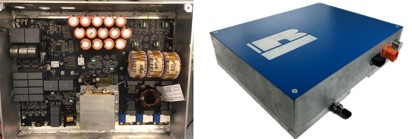
BIDIRECTIONAL INTEGRATED ON-BOARD CHARGER AND DC/DC CONVERTER
What operational modes does the integrated system support?
The integrated OBC–DC/DC system developed by Ricardo supports a wide range of critical vehicle functions.
It enables charging of the vehicle’s high-voltage battery directly from the AC grid, accommodating both single-phase and three-phase input modes to suit various infrastructure environments. Simultaneously, it supports charging of the low-voltage battery and powers low-voltage vehicle loads, drawing energy either from the AC grid or the high-voltage battery depending on operational conditions.
Notably, the system also facilitates vehicle-to-grid (V2G) functionality, allowing bidirectional power flow by delivering AC power back to the grid from the high-voltage battery supporting energy resilience and grid balancing. Additionally, during vehicle startup, the system manages the pre-charge of the high-voltage bus using energy from the low-voltage battery, ensuring safe and controlled initialisation of high-voltage components.
This multifunctional capability within a single, compact unit showcases the benefits of deep integration in modern EV power electronics.
What are the benefits?
The integration of the OBC and DC-DC converter into a single unit delivers substantial benefits beyond functional consolidation. By sharing the high-voltage interface and implementing a unified digital control platform, the system achieves a significant volume and mass reduction in the order of 25%, contributing to more compact and flexible vehicle packaging.
The use of a single transformer with three windings to serve both high-voltage and low-voltage outputs enhances efficiency and enables higher power density, while also reducing the number of components required. Most notably, the integrated design leads to a 35% cost reduction compared to standalone OBC and DC-DC units, primarily by eliminating duplication in key areas such as the transformer, control circuits, and housing. These advantages make the integrated system a compelling solution for scalable, cost-effective electrification in future EV platforms.
Conclusion
Integration of multiple electronics components in electric vehicles will drive lower cost and mass. Ricardo’s on-board-charging and DC/DC converter technology achieves 35% cost savings and 25% mass reduction. The trend will continue to integrate more components to achieve X-in-1, for high volume production vehicles as we have seen recently with mainstream OEMs. Ricardo can accelerate your vehicle integration with pre-developed advanced power electronics solutions.
This project has received funding from the European Union’s Horizon Europe research and innovation programme under grant agreement No 101056756 and UKRI's Horizon Europe Guarantee under reference No 10073057.
Note: The authors will be speaking at this summer's PCIM Expo & Conference in Nuremberg, Germany (June 2026) - an international event for Power Electronics, Intelligent Motion, Renewable Energy and Energy Management, bringing together product development and research experts from both industry and academia. https://pcim.mesago.com/nuernberg/en.html#expo-conference

Electrification solutions: powering the future with innovation
At Ricardo, we are at the forefront of electrification, solving the most complex challenges in propulsion and energy systems. With over 100 years of expertise, we operate as a trusted partner, delivering cutting-edge solutions behind the scenes.
We provide end-to-end electrification capabilities as well as targeted solutions right sized to meet the need of the client. We specialise in optimising cost, performance, and efficiency across xEV systems, auxiliary power, and stationary energy solutions. From advanced energy storage to integrated ePowertrains and electronics, we simplify complexity, delivering smarter, more sustainable mobility and energy solutions for the future.


