





Placing chemical products on the market in South Korea


As South Korea tightens its chemical regulatory landscape, companies placing substances or mixtures on the market face a decisive moment: from 1 July 2026, when all Safety Data Sheets must comply with the new MoEL format.
With K‑REACH registration duties, updated SDS obligations and in‑country emergency response requirements converging, the window for action is rapidly closing. For organisations exporting to Korea – or already operating in the market – now is the time to ensure your product portfolio is fully aligned with the new rules to avoid costly delays, compliance failures or market disruption.
K-REACH
K‑REACH is South Korea’s chemical control law, formally known as the Act on the Registration and Evaluation of Chemicals (K-REACH). It was passed on 30 April 2013 and has been in force since 1 January 2015, with the most recent amendment on 7 August 2025 strengthening registration obligations and compliance requirements.
Under K‑REACH, the Ministry of Environment (MoE) oversees chemical registration and evaluation, supported by the National Institute of Chemical Safety (NICS) for substance registration, the Korea Environment Corporation (KECO) for pre‑registration and exemption confirmations, and the Ministry of Employment and Labor (MoEL), which manages related OSHA responsibilities, including workplace classification and labelling.
Who should comply with K-REACH?
Any business that manufactures, imports, or places chemical substances on the Korean market may have compliance obligations. In practice, the following actors must comply:
Korean manufacturers: Companies manufacturing chemical substances in Korea must comply with K-REACH.
Importers into South Korea: Companies importing chemicals into South Korea are fully subject to K-REACH. This may include import of substances on their own, import of substances in a mixture, or import of articles where substances requiring registration are intentionally added.
Foreign manufacturers: Foreign manufacturers outside Korea are not directly regulated but they need to comply with K-REACH when exporting their chemical substances to Korea. To manage this, foreign manufacturers may appoint an Only Representative (OR) in Korea to take over registration and communication duties.
Type of substances under K-REACH
|
Type of Substance |
Description |
Regulatory Requirements |
|
Existing (Phase‑in) Substances |
Already on the Korean market before K‑REACH; listed in KECI. |
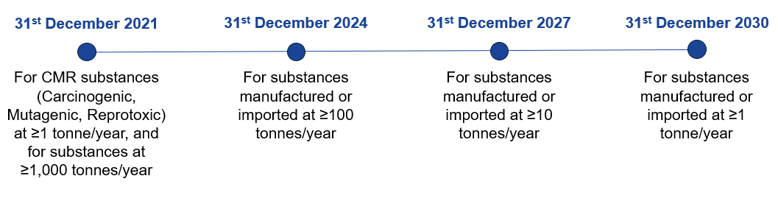
Pre‑registration allowed during grace period; full registration required by deadlines based on tonnage. |
|
New (Non‑phase‑in) Substances |
Not listed in KECI; considered new to Korea. |
Must be registered before manufacture/import. From 2025: registration ≥1 t/year; notification <1 t/year. |
|
Priority Existing Chemicals (PEC) |
High‑concern substances designated by MoE. |
Immediate registration required if imported in Korea ≥1 t/year; no grace period. |
|
Priority Control Substances (PCS) |
Substances with significant health/environmental risks. |
If product contains PCS >0.1% and ≥1 t/year, reporting required before manufacture/import; may face restrictions or prohibitions. |
Deadlines for registration under K-REACH
Substances exempted under K-REACH
There are two types of exemptions under K-REACH:
|
Exemption Type |
What It Means |
Examples of Substances |
|
Confirmation‑Required Exemption |
You must submit proof to authorities to receive official confirmation of exemption. |
R&D substances, surface‑treated substances, non‑isolated & certain isolated intermediates, Polymers of Low Concern (PLC). |
|
No‑Action‑Required Exemption |
No submission needed; companies self‑determine that exemption applies.
|
Substances regulated under other Korean laws (pharma, cosmetics, pesticides, fertilizers, food‑related substances, medical devices), naturally occurring unmodified substances
|
Safety Data Sheets
In Korea, manufacturers/importers are required to use KOSHA regulated SDS. These SDS requirements are aligned with the Globally Harmonized System (GHS) and are enforced under the Korean Occupational Safety and Health Act (OSHA) by the Ministry of Employment and Labor (MoEL).
Under MoEL Notice No. 2025‑50 (MOEL), Korea has recently updated its SDS rules to reflect the most recent GHS criteria and harmonize hazard communication with revisions introduced under K‑REACH. The amended requirements revise key SDS sections – particularly sections 2, 11, 12 and 15 – to ensure that hazard classifications fully align with updated GHS categories and K‑REACH hazard data. As a result, you must have a unique SDS specifically tailored for the Korean market and a generic SDS will not suffice.
All SDS must be prepared in accordance with the updated MoEL format and submitted through the MoEL/KOSHA SDS submission portal before the manufacture or import of chemicals. Beginning 1 July 2026, the use of the updated SDS template becomes mandatory. Failure to adopt the new format may lead to submission rejections, non‑compliance findings or administrative penalties including fines.
Emergency telephone number
SDS require an emergency contact number in section 1.4. This should be a domestic South Korea number such as the importer’s emergency number, or the emergency number of an agent designated by an overseas manufacturer. A response in Korean language should be available.
How Ricardo can support you?
If you are placing a product on the market in South Korea, Ricardo can support you with your regulatory obligations including:
- The pre-registration and full registration of your substances under K-REACH.
- SDS preparation for manufacturers/exporters and importers within Korea.
- Emergency response number, ensuring full K‑REACH compliance for companies that do not have an in-country presence.
Struggling to keep up with complex and evolving chemical regulations across global markets?As highlighted on our Chemical Regulatory & Compliance page, navigating REACH, GHS, SDS and hazardous goods requirements can be complex and time-critical, and with regulations constantly evolving, organisations need clear, practical support to stay compliant, maintain market access and make faster, more confident regulatory decisions. Explore our Chemical Regulatory & Compliance solutions and stay ahead of regulatory change > |
 |


