





XL-Connect: Integrated bidirectional DC/DC converter and On-Board-Charger
Ricardo has developed a highly integrated DC/DC converter and on-board-charger (OBC) for use in passenger vehicles with bidirectional capability to allow the export of energy to the electricity grid when cars are connected to the supply at home or place of work. This will enable users to sell energy at premium rates when the electric utility most needs it at peak hour.
Challenge
Electric vehicles (EV) today have separate components to perform the functions of charging the high voltage (HV) battery (the OBC) and the 12V low voltage (LV) battery (the DC/DC converter). Furthermore, these components are, in most cases, unidirectional, allowing flow of power from the electric utility to the HV battery and from the HV battery to the LV battery respectively.
With more aggressive decarbonisation targets and higher deployment of renewable energy, having access to large-scale battery energy storage is very attractive to electricity operators. In a future where all passenger cars are electric, there could be 250 million batteries connected to the utility. Using a conservative value of 50kWh per battery, that fleet represents 12,500 TWh of energy storage at their disposal (compare to approximately 4,000TWh used by the whole of Europe in 2024).
Approach
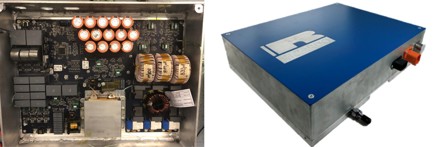
Ricardo has designed a highly efficient bidirectional OBC based on a resonant power electronics topology that integrates the function of the DC/DC converter to the same isolation transformer. The design leverages the high efficiency of wide bandgap semiconductors, Silicon Carbide used in the high voltage power stages and Gallium Nitride used in the low voltage power stages.
Together with Vehicle to Grid (V2G) control protocols based on ISO 15118-20 the unit allows for bidirectional power flow on demand from the EV supply equipment (EVSE). Units were built and bench tested for bidirectional power flow and integration with the charging station.
Results
The integrated DC/DC-OBC was tested in bench environment up to 11kW and displayed a peak efficiency of 94%. The integration of DC/DC and OBC resulted in mass savings of 25% and material cost savings of 35% compared to two individual units.
This A-Sample design offers an excellent starting point for companies looking at offering V2G capability. With Ricardo’s turnkey development capabilities we can progress this technology through to B- and C-Sample within 12 months.
This project has received funding from the European Union’s Horizon Europe research and innovation programme under grant agreement No 101056756 and UKRI's Horizon Europe Guarantee under reference No 10073057.