





The wait is over: UK water reform White Paper released




According to the UK Government, in England and Wales, the water industry is broken – or at least it was, six months ago, when it declared that today marks the start of a water revolution. Alongside a selection of headline reforms, the government committed to a swift and holistic response to a national inquiry into the water sector.
As of Tuesday 20 January, the wait is over. The government released A New Vision for Water, a White Paper that calls for a once in a generation shift in the water sector. This article provides a rapid overview and some initial insights from our experience working in Australia and the UK. We look forward to delving deeper into individual topics in coming weeks.
How did we get here?
Last July, the Independent Water Commission’s Review led by Sir John Cunliffe (the Cunliffe Review) made wide-ranging and significant recommendations to repair a system that is evidently not delivering. Issues include pollution problems, aging networks, underinvestment in maintenance as well as new infrastructure, water restrictions and concerns about water security, soaring customer bills and a failure to deliver the water infrastructure required to support the economy.
Government has failed to set clear objectives, priorities and ambitions for the sector and the regulator (Ofwat) will be abolished for failing to effectively regulate the sector. There are almost daily headlines covering environmental breaches, record fines and prolonged service outages effecting tens of thousands of customers. England’s largest utility, Thames Water is relying on a court-approved £3bn bailout loan with an interest rate nearing 10% and is engaged in a prolonged negotiation to substantially increase prices.
The scope and scale of reform proposed by the Cunliffe Review was large and comes at a time when significant investment is required (with £104bn approved for the 2025-2030 pricing cycle and up to £290bn forecast out to 2050 by the National Audit Office). The review recommendations piqued interest in Australia and drew some parallels with the challenges and opportunities facing the water sector. It provides a compelling case for continued improvement, greater investment and ongoing reform. It also gives a stark warning of the risks that all stakeholders bear when things slide, this includes government, regulators, utilities, customers, the environment and investors.
For those requiring a refresher, over more than 400 pages, the Cunliffe Review recommendations covered:
- government vision, policy and objective setting,
- root and branch reform of environmental, economic, technical and health regulation (under a single entity),
- major revision of the water planning framework and establishment of regional planning authorities
- a range of specific recommendations to improve legislation, regulations and the regulatory framework, planning and management, corporate governance and industry practices and asset management.
Of interest to many of us in Australia, the Cunliffe Review scope nor the government response consider the issue of public vs. private ownership. According to the Department for Environment, Food and Rural Affairs (DEFRA) the cost of nationalising the water industry could reach £100bn and would increase UK government debt levels by 5 per cent. These are astronomical numbers and have been the subject of much debate, however they continue to underpin the current framing of the reform agenda in this regard.
For several decades, Australia and the UK have looked to each other for ideas and insights on how to better govern and manage the urban water sector – aligning on many of the same fundamental principles on economic regulation and corporatised service delivery but adopting different pathways to pursue them (most notably diverging on private ownership). The water sector in England and Wales is now at a critical juncture where the status quo is not sustainable and the way forward requires a significant step-change in approach from a sector that has lost the faith of the public.
The remainder of this article unpacks the government’s White Paper outlining the its vision for the water sector.
What is the new vision for water?
The White Paper commits to the following outcomes: safe and secure supply; protected and enhanced environment; and a fair deal for customers and investors. Importantly, this is to be achieved in a manner that is more efficient and more integrated. The White Paper acknowledges that the policy, planning and regulatory framework has lost direction through piecemeal and disjointed changes that lack coherence.
So what is changing?
The White Paper outlines reforms across five themes, each discussed in brief below.
1. A new direction for water
A major finding from the Cunliffe Review was the lack of clear strategic direction for the sector with Strategic Policy Statements issued to the regulator (Ofwat) creating fragmented and short-term direction for the sector. Strategic Policy Statements related to the mandate of Ofwat as the economic regulator with separate ad hoc advice from other regulatory bodies issued under separate arrangements. This will be replaced by issuing formal and integrated strategic guidance every 5 years, with a commitment to ensuring a coherent and longer-term outlook that provides greater stability for the regulatory framework.
Part of setting the new direction will also include revisiting and potentially rationalising legislation to create a more streamlined and coherent framework that responds to modern issues and expectations, sets appropriate requirements and transitions from a compliance-focused approach to one that drives the best outcomes for customers.
Planning frameworks will also be overhauled, with the existing suite of up to 20 separate planning instruments rationalised. The water industry (utilities) will be focused on two plans, water supply and water environment. This will be supported by a regional planning function focused on supporting national strategic objectives. Achieving this change will include some institutional and governance reform and is expected to improve efficiency through reducing various responsibilities and functions across multiple entities. It appears to be pared back from the Cunliffe Review recommendations on planning which called for regional planning authorities to act as system planners with a wider portfolio of responsibilities. The targets and ambitions that underpin planning will also be revisited including for example, the appropriateness of Water Framework Directive requirements.
2. Resetting regulation
In its initial response to the Cunliffe Review last July, the UK government made the headline announcement of abolishing Ofwat and establishing a single integrated water regulator. The White Paper provides some further detail on how it expects this to occur (see Figure below).
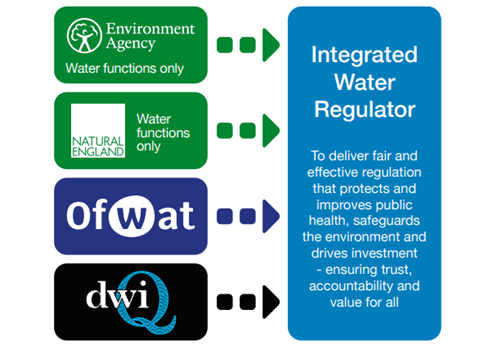
The core mission of the new regulator will be to deliver fair and effective regulation that protects and improves public health, safeguards the environment and drives investment. Within this mission, its objectives will be to:
- Protect public health and the environment.
- Ensure water company bills are fair and affordable for customers.
- Strengthen the water sector’s financial resilience and ability to attract the long-term investment required to meet its ambitions, ensuring that the sector supports economic growth.
- Provide robust oversight of water companies to maintain and enhance the long-term health and resilience of their infrastructure
At face value, these objectives are quite broad and subjective. Given this, the White Paper commits to developing decision-making principles for the regulator to be applied when identifying the path to deliver the best outcomes. These principles will be critical in determining how the regulator interprets and implements its objectives and will be integral to the success (or failure) of the shift to an integrated single entity.
The White Paper supports the Cunliffe Review recommendations for the new regulator to adopt a supervisory approach that is tailored to individual water companies rather than relying on industry-wide benchmarking and economic modelling. It states that benchmarking and modelling will continue to be an important tool to avoid the misuse of monopoly power, and that this will be enhanced through company-specific expertise within the regulator and contextual judgement. This combined approach contrasts with the approaches generally adopted within Australia and will provide an interesting counterpoint to how different regulatory frameworks can be applied. Within this context it is also envisaged that there will be an increase in the technical capacity of regulation and regulatory implementation through the appointment of a Chief Engineer within the regulator.
The White Paper pledges to introduce a new Performance Improvement Regime (PIR) for poorly performing water companies to enable a proactive approach with both supportive and punitive measures. This aligns with the papers broader focus on ensuring a more proactive approach from the new regulator to intervene earlier, where appropriate, and avoid potentially serious situations (like the current situation) from occurring again in the future.
The regulatory reforms will embed the concept of ‘constrained discretion’ into the reset of water regulation. The objective of this shift is to empower the regulator with greater flexibility to support improved outcomes for people, the environment, and economic growth, within the constraints set out in legislation. That is, a focus on regulating to outcomes rather than process – where appropriate.
It is acknowledged that these regulatory reforms will take time to design and implement. Therefore, amendments are being implemented to enable the current regulators to enforce penalties more expediently and with more proportionate penalties while enhancing resources to ensure the enforcement is effective and timely.
3. Attracting investment
Fixing a water sector that is not delivering comes with a cost, which means it needs to be investable. The government has been trying to walk the line between addressing very legitimate customer and community concerns over utility business performance and financial gaming of the system, without scaring away the investment the sector needs to correct course.
To help secure the investment needed for the sector, reforms under this theme include recommitting to 5-year price review cycles but with additional consideration of 5-, 10- and 25-year planning time horizons. This will provide consistency and aligns with the strategy and planning reforms under the first theme.
The increasingly complex incentives and penalties that make up the regulatory framework will also be wound back. These ‘fixes’ have been patched over time with mixed results – sometimes improving outcomes, but also increasing regulatory complexity, the volatility of investor returns and a focus on short-term results. In contrast, the new incentive framework will aim to be simpler, proportionate and more predictable.
The government has also committed to lowering the barrier for projects to be delivered through competitive tender by third parties under its Specified Infrastructure Projects Regulation (SIPR). This arrangement effectively ringfences discrete infrastructure projects under a separate project licence issued by the regulator – opening the market and enabling greater competition. SIPR will be expanded beyond sewage-focused projects to all water infrastructure.
4. Putting customers first
A cornerstone of the customer-centric focus of the reforms is the establishment of a new, independent Water Ombudsman. This ombudsman will be a standalone entity that is specific to the water sector, but will seek to apply best practices from other sectors with customer ombudsman models. It is envisaged that this new ombudsman will have clearer powers than the existing voluntary complaint system, strengthening customer redress (consistent with recommendations from the Cunliffe Review).
The paper notes that the most important role the water sector has for customers is ensuring that sufficient safe drinking water is available. To this end, the White Paper states that the new regulator will convene a drinking water quality advisory group that will be given the responsibility for making regular recommendations for updating drinking water regulations to help protect and improve public health and consumer confidence in water quality.
Public awareness and interest in the quality of water has grown in recent years (especially in light of the challenges the industry has faced). Given this, there is a focus in the paper on enhancing the customer-centricity of the industry. This is not just through independent mechanisms such as the proposed ombudsman, but also through new customer panels, an enhanced Consumer Council for Water advocacy role, and a strengthening of community voices through enhanced regional planning.
Overall, the White Paper aligns with the Cunliffe Review on key recommendations regarding the introduction of an independent water ombudsman scheme and emphasises the need for strengthened customer protections within the industry. It is not explicit however on other recommendations, such as a national social tariff, customer appeals rights and affordability safeguards. This does not necessarily mean that these recommendations have not been adopted by government – as the theme of the White Paper in general is about moving towards a greater customer-centric direction – it may be that further detail on these customer-centric measures will be included in the Transition Plan later in 2026.
5. Clear action for clean water
This reform theme largely focuses on water pollution linked to England’s combined wastewater and stormwater systems that date back to the Victorian-era. Commitments include upgrades and a focus on pre-pipe solutions as well as removing water industry self-monitoring.
The reform theme also addresses agricultural pollution with a commitment to consolidating and strengthening national standards.
Further details on this reform theme are available in the White Paper, however this summary has been kept brief as the challenges and issues are largely different to the Australian water sector due to the hydrology, population and development density and legacy infrastructure in place in England.
6. Water security
The water security reform theme is wider ranging. It spans asset condition, maintenance and standards, integrated urban planning and development, water efficiency, innovation and supply chains.
Failures across the water sector in England have increasingly highlighted underinvestment in both asset maintenance and in asset data and monitoring – historically measured by Ofwat through ‘asset failure metrics’ rather than assessing asset condition. This appears set to change through a stricter standards and a supervisory approach to regulation. This is a salient point for other locations that may be inching toward a similar position with poor data, aging networks and underinvestment.
The White Paper commits to enhanced asset maintenance and the introduction of statutory resilience standards. It also acknowledges the need for improved baseline knowledge of current asset condition as a starting point and flags the transition to engineering-based supervision and oversight under the new regulator’s Chief Engineer. These requirements will be backed by the commitment to support greater investment in maintaining and renewing assets – including revisiting depreciation rates, ringfenced funding allowances and removing perverse incentives to keep costs low at the expense of asset maintenance.
Under ‘water efficiency’ the White Paper commits to increased roll-out of smart meters, efficiency incentives and establishment of a Mandatory Water Efficiency Label (not dissimilar to the Water Efficiency Labelling Scheme in Australia). There is also a commitment to revisit tariff structures as a means to improve efficiency (with some wholesale charges currently under a declining block tariff).
Initial reflections
The Press Release hails this as a once in a generation opportunity to overhaul the water sector and correct course. The commitments broadly align with the Cunliffe Review recommendations, and indeed constitute an ambitious reform agenda.
The White Paper starts to provide some colour on where the sector should be heading but in doing so also starts to highlight the quantum of change required, the detail still to be worked through and the work that lies ahead. Major governance and institutional reform of the regulator, legislative changes, development of new standards, planning and protocols and more – these changes do not come easy, quickly or cheaply.
As we continue to digest the White Paper and stakeholder responses, the following insights are beginning to emerge:
- Long-term commitment and a focus on the ‘how’: The White Paper has taken six months and will be followed by a Transition Plan that outlines how the reform agenda will progress as well as the new strategic direction for the sector. Assuming this takes a similar amount of time (if not longer) this will be nearing a quarter of a pricing cycle to arrive at what, in many respects, will be the start line. It also leaves a relatively ambitious timeline to see through legislative, institutional and regulatory reforms ahead of the next pricing cycle from 2030. This is not intended as a critique on the rate of progress but to highlight that reform is a slow burn that often extends beyond public and political attention spans. Significant announcements and commitments to change, followed by years if not decades of work and ongoing commitment to getting changes across the line. This is true of the Australian experience over the last two decades and will be true for the UK as well. It is also often an overlooked and undervalued truth when committing to reforms and is arguably why it often feels like the water sector is playing some form of catch-up. The Transition Plan will have to do a lot of heavy lifting.
- Importance of getting regulation right: As evidenced by the focus (firstly from the Cunliffe Review and then the White Paper), regulation plays an extremely important part in ensuring the water sector can achieve its overarching objectives. Getting regulatory frameworks (or their implementation) wrong can have severe consequences for households, communities, the environment and even future generations. The White Paper provides some high-level structural direction, however the effectiveness of all of these proposed reforms will largely depend on the detail that is still to come. There is a risk that the industry ends up in a similar position in the future even after these substantial reforms – after all, the government (and regulators) at the time of implementing the existing regulations would certainly not have envisaged the situation that the sector currently finds itself in. Given all of this, it is important not to rush the establishment of these more detailed regulatory reforms, but to undertake careful and meaningful analysis, while also not losing the momentum that the sector (and the public) currently has for undertaking such important reforms.
- Lessons for the Australian water sector: The current situation in England serves as an example of the risks and issues that can emerge and the drastic measures and changes required in response, if left unattended. Importantly, the diagnosis of issues and sweeping reform agenda point to no one, single point of failure or gap but a failure to adequately address multiple compounding issues over a period of time as the sector drifted from its foundations. A much more desirable outcome would be to avoid the once in a generation reform agenda in response to significant failures and to instead chart a smoother path to continuously improving performance, securing adequate investments and delivering the right outcomes. The question is, which path is Australia on and are we taking the hard steps now or inching toward a forced reset.


