





Why racing relies on collaboration and integration


Modern Formula 1 cars are highly sophisticated machines that integrate over 13,000 components [1] across a multitude of engineering disciplines, from powertrain and aerodynamics to electronics and software. The relentless development of these parts requires teams of up to 1,200 employees [2]. Whereas the naturally aspirated, mechanically driven cars of the 1970s for example, were far simpler and featured fewer parts along with smaller teams of around 20 staff [3].
This rise in the number of parts and people reflects motorsport’s relentless pursuit of performance. ‘The drive to win races, combined with the shift towards electrification, has accelerated innovation and significantly increased the complexity of modern racecars,’ highlights Connor Murray, Motorsport Sales Lead at Ricardo. ‘This complexity demands specialists in each area, who must work seamlessly together to integrate their technologies across the car.’
Technology is not the only factor accelerating collaboration, but also the commercialisation of racing. The recent surge in motorsport’s popularity has led to an influx of sponsors, with Formula 1 now boasting a record number of 368 commercial partners [4].
‘As motorsport continues to become more commercialised, sponsors and stakeholders expect results which increases the pressure on teams to be competitive,’ says Murray. ‘With more now riding on race results, combined with cost restrictions and evolving regulations, it really takes a collaborative effort to deliver a strong racecar.’
Discover our motorsport bespoke solutions
The growing integration in modern gearboxes
One area that requires significantly more collaboration than in the past is the transmission. Racing’s switch to electrification means the gearbox must be engineered to suit the different characteristics of ICE, hybrid and electric drive.
‘For hybrids, the torque from the engine and regenerative motors needs to blend together effectively to deliver the desired torque at the wheels,’ explains Steve Blevins, Head of Engineering at Ricardo. ‘Therefore, most hybrid vehicles use automatic or DCT [Dual Clutch Transmissions] gearboxes.’
‘Whereas for electric racecars, the motors provide consistent torque, so a single speed gearbox is typically suitable,’ continues Blevins. ‘Although the most efficient and lightweight approach is actually to use small, power-dense motors that spin extremely fast. These fast speeds result in less torque, but this can be overcome with a parallel axis arrangement where a single motor drives the front wheels, and the torque is split via a differential. This achieves a single or double stage reduction, slowing down the driveshaft, increasing torque and is common in championships such as Formula E.’
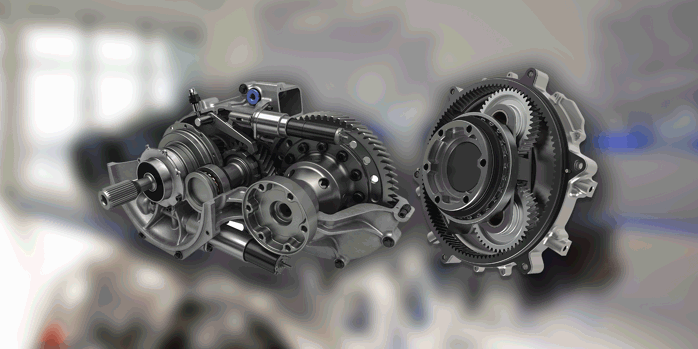
The complexity of modern racing transmissions demands a highly coordinated approach, where teams, manufacturers, and suppliers all need to work together to deliver a high-performance package. For example, WEC’s LMDh class runs a standard transmission system, however to meet the requirements of these advanced hybrid hypercars the product was delivered through a collaboration between three technical partners.
‘Achieving an efficient and reliable gearbox in modern racing relies on the integration of numerous components and input from multiple engineering disciplines to achieve a holistic vehicle solution,’ reveals Murray. ‘Even in smaller championships, where more standardised parts are used, careful coordination is still required to ensure compatibility and consistent performance across the vehicle. Only at grassroots level, where simpler mechanical systems and manual gear shifting are still common, is the level of integration and cross-functional collaboration more limited.’
Ricardo’s collaborative engineering philosophy
Whether it’s a bespoke transmission for an individual team or a spec gearbox for an entire championship, system integration is front of mind for Ricardo’s engineers. ‘We don’t develop a gearbox solution without considering how it integrates into the car,’ says Murray. ‘Every design decision, from concept to final delivery, is made with integration and efficient performance in mind. This is especially important when interfacing with customer-supplied or third-party components, where we must ensure all systems operate cohesively with our gearbox design.’

‘Relationships in motorsport are more important than ever before,’ concludes Murray, ‘Developing a working partnership with our clients is at the heart of our approach to achieving seamless integration. This starts even before the programme kicks off with regular touchpoints that enable us to work more efficiently and effectively together. This allows us to keep all parties aligned on design objective and catch discrepancies before they become issues.’
‘The Ricardo team are heavily invested in the on-track success of our partners, and this approach means that we can deliver a transmission solution that best suits their application.’
References
[1] 2021. Explained | How to make an F1 car part [Online]. Aston Martin Aramco Formula One™ Team
[2] 2023. Insider’s guide: Who does what in an F1 team? [Online]. Motorsport.com
[3] 2014. F1's Population Explosion [Online]. Racer.com
[4] M.M.B., 2026. What ‘The Grid’ reveals about F1’s commercial structure [Online]. Sector


Have you got a question about this article? Contact us here:
Can't see this form? Email us here